Page 1 of 1

Headspace gas chromatography sample preparation

Posted: Tue Oct 04, 2022 5:41 am
by antonio_rosato
hi to all. I'm facing to headspace sampling for gas chromatography just now.
I'm wandering if it is necessary that the sample has to be completely dissolved in the solvent you've chosen to carry out the analyses of trace solvents/impurities.
Specifically, I'd like to know quantify and analyze an analyte that is part of solvate with the API I'm interested. This API is not soluble in the solvent (water) I've chosen to perform the analyses, and i wouldknow if i will be still able to see the analyte though the API is not soluble in water.
thank you
Re: Headspace gas chromatography sample preparation

Posted: Tue Oct 11, 2022 5:56 pm
by rb6banjo
The short answer is that it depends.

Certainly it's best of the solid sample is completely soluble in the solvent. That way, you'll have no undue influence of the matrix on how the analyte partitions into the headspace.

However, even if it doesn't completely dissolve, you may still get good results but you may have to calibrate in the matrix (method-of-standard addition). If you verify that the analyte partitions predictably (hopefully linearly) out of the solvent/solid-slurry mix then you can use that sample prep to generate quantitative information about your sample.

I'm doing something very similar with a plant right now. The plant matter isn't soluble in the water but I can get a linear response for the analytes out of the plant/water slurry.

Re: Headspace gas chromatography sample preparation

Posted: Wed Oct 12, 2022 1:49 pm
by rb6banjo
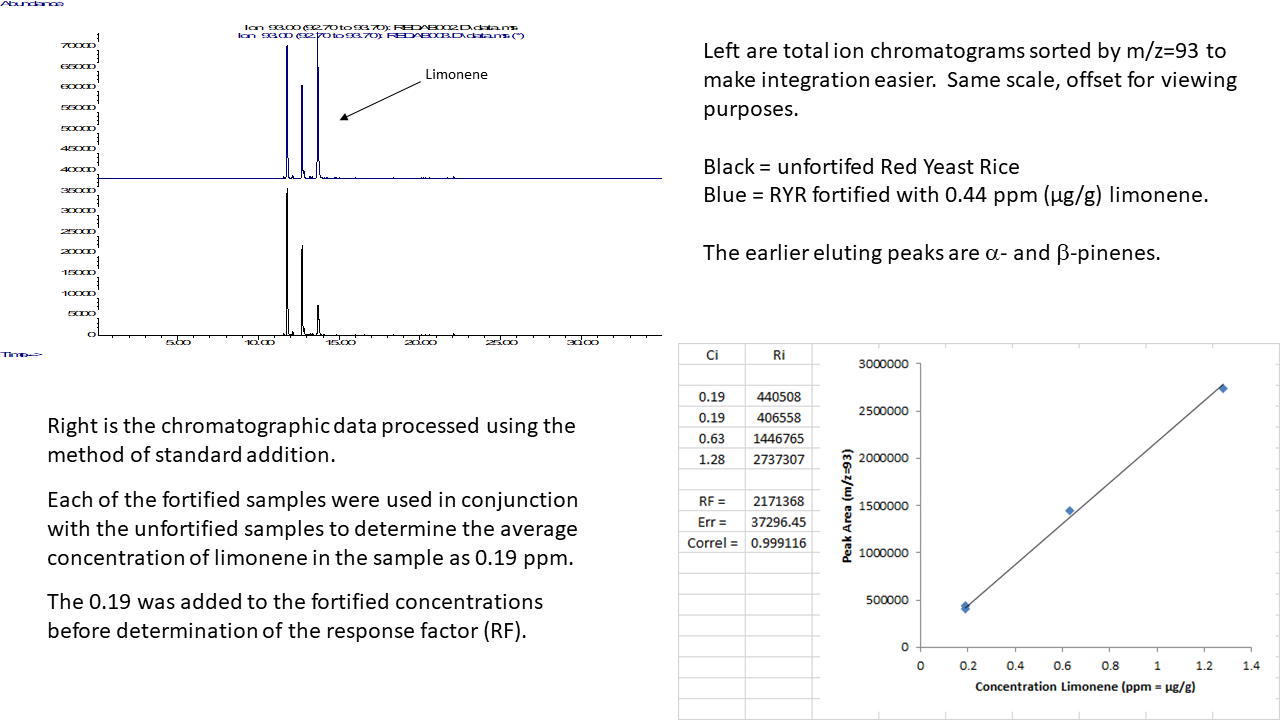
A friend of mine wanted to start taking "Red Yeast Rice" as a dietary supplement. I'd never heard of it before so she gave me some capsules for analysis. I slurried some up in water and discovered that there wasn't much volatile "stuff" in there but there were some trace terpenes (alpha and beta pinene and limonene). It's not completely soluble in water so I analyzed the slurry using the method of standard addition:

Prepare 4 samples of RYR (0.050 g + 1.00 mL of DI water).
Seal 2 with no addition of limonene
To the others add 0.2 microliter and 0.5 microliter of a 109 ppm standard of limonene in methanol. That's 0.44 ppm and 1.09 ppm in the RYR.

Analyze all 4 by the same headspace GCMS method.

If I performed the same experiment with no RYR added, and the response factor was the same, I could use external-standard calibration for future work. If the slopes are dramatically different (i.e., would skew the results if used), then you have to always calibrate in the matrix.

https://i.postimg.cc/bY0JYFkH/Limonene- ... t-Rice.png